Which string instrument fits?
Choosing an instrument is not a decision about talent. It is a decision about sound, physical comfort and the kind of listening you are willing to practise. Anyone who learns a string instrument trains not only the fingers but also the ear and patience.
Four voices, four paths
The string family shares one idea: a bow sets a string in motion, and the body of the instrument shapes the sound. Yet every instrument feels different. The descriptions below are not a ranking; they are orientation.
Violin
The violin is the highest voice of the string section. Its sound is bright, agile and often leading. It demands fine intonation, because small uncertainties in the high register are clearly audible. It suits people who enjoy melodic lines, quick reactions and precise work.
There are no special physical requirements, but a degree of fine motor control and a willingness to listen and correct are helpful. Children often start with a small size; the instrument grows with them. Orchestral places are often easier to find than for lower strings, because violins are needed in large numbers.
Viola
The viola is the middle voice: warmer, darker and a little more reserved than the violin. It is larger and asks for a slightly wider arm position. It suits people who enjoy shaping the connection between melody and bass, who do not always need to be in the foreground, and who love a soft, earthy sound.
The technique is close to the violin, but the sound is different: the viola speaks a little more slowly and rewards calm, sustained playing. In ensembles it is often the voice that holds the room together. For children, size matters; good advice is more useful than a fixed age recommendation.
Cello
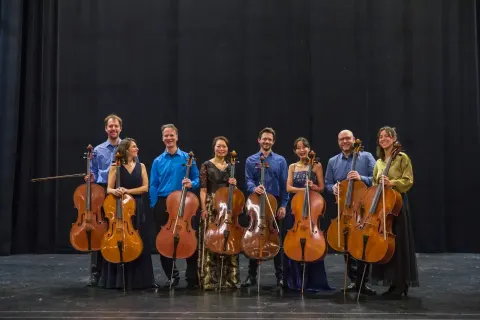
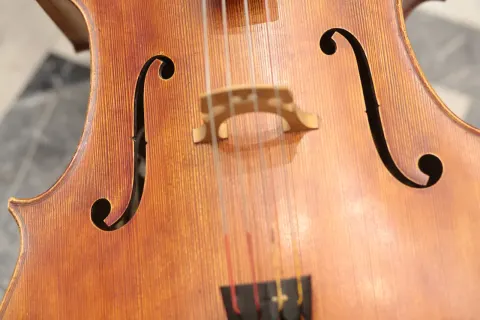
The cello sounds close to the human voice: warm, deep and carrying. You play sitting down, the instrument rests against the body and is held by the knees. This closeness makes the cello physically comfortable and emotionally immediate for many people.
A suitable size and arm length are important, as is a love of a sound that unfolds rather than sparkling immediately. Children can start early with small cellos; the right size matters more than the calendar age. The cello carries melody and bass at once, which makes it versatile in chamber music, orchestras and teaching.
Double bass
The double bass is the lowest voice. It is large and heavy and requires a different posture: standing or sitting on a high stool. Its sound gives an ensemble foundation and warmth. It suits people who like physical work, love low notes and do not mind standing in the background at times.
The bass is often started later than the other strings, frequently between eight and ten years old, because size and arm span need to fit. It is in demand in jazz, orchestras and chamber music; the repertoire is varied, even if smaller than the violin’s.
Similar instruments and related paths
Anyone interested in strings does not have to decide immediately. A string class offers a group start, with smaller instruments and no pressure to perform. Chamber music can later make a second instrument worthwhile: someone who plays cello and learns viola suddenly understands the middle voice differently. A move within the family is also possible – from violin to viola, or from cello to double bass – when body and sound preferences change.
What matters is that the instrument fits the person, not the other way round. An instrument that is too large leads to tension; one that is too small creates unnecessary effort. Trying things out is better than any table.
Other instruments taught at music schools
Music schools teach far more than strings. The following groups give an overview of typical instruments, their sound idea and the prerequisites that should be discussed with the teacher.
Keyboard instruments. Piano and keyboard are harmonically versatile and visually easy to understand. They require enjoyment of coordination and polyphonic listening; the hands work independently. Piano is often a good start because it makes notes visible and lays a foundation for music theory.
Plucked instruments. Guitar, electric guitar and bass guitar combine rhythm and harmony. They require patience with chord changes and a degree of finger dexterity. Classical guitar, electric guitar and bass differ in sound and repertoire but share a closeness to song and band playing.
Woodwinds. Recorder, flute, clarinet, oboe, bassoon and saxophone live from breath. They require healthy breathing, enjoyment of long notes and a willingness to control pitch and tone colour carefully. The recorder is a low-threshold start; oboe and bassoon demand more stamina and often a later start.
Brass. Trumpet, horn, trombone and tuba need breath, lip strength and endurance. The sound comes from lip tension, not from keys or strings. Children often start with smaller instruments or mouthpieces; the teacher’s advice is essential.
Drums and percussion. Rhythm, coordination and body awareness are central. An early start is often possible, beginning with small drums or percussion; a full drum kit comes later. Enjoyment of movement and precise timing are the main requirements.
Voice. The voice is the oldest instrument and needs particularly careful guidance. Singing lessons often begin in puberty or later, because the body and voice are changing. Enjoyment of sound and a willingness to work gently are essential.
How the decision becomes easier
At the beginning, the question is not “Which instrument is the best?” but “Which instrument do I want to hear and hold?” A visit to a specialist shop, a conversation with a teacher and trying several sizes will clarify more than long comparisons. Renting is a sensible first solution, especially for children who are still growing.
If you are unsure, you can start with one instrument and switch later. Musical experience is not lost: ear, rhythm and discipline travel with you. The most important criterion remains that you enjoy picking up the instrument.