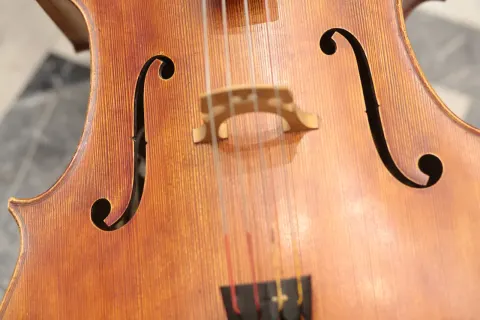
Finding the right size.
Why a cello that is too large is not only uncomfortable but changes how you hear – and how to determine the right size without a table.

Parents often ask for a number: ‘What size does a seven-year-old need?’ The honest answer is that it cannot be read from age alone.
Why size matters
A cello that is too large forces the body into a posture that does not work in the long run. The left hand reaches the low positions only with a stretched arm, the bow no longer meets the strings at a right angle, and the sound becomes thin because pressure replaces what natural arm guidance should provide.
The real problem, however, is not the posture. It is the feedback the child receives: the instrument does not sound as it could – and the child concludes that they are not playing well.
Sizes at a glance
Cellos come in several sizes, from a small eighth size for very young children to quarter size and finally the full instrument. Exact measurements differ between makers, so any table is only a guide.
More important than the number is the fit: does the child sit upright without lifting the shoulders? Can they guide the bow over its full length without overstretching the arm? Does the left hand reach the lowest string in first position comfortably?
How to check
The most reliable way is an appointment at a specialist shop. There the instrument can be held, tried and compared with the next size. A child often notices which instrument feels lighter – even without words for it.
For an initial orientation, the interactive instrument finder can help. It asks for height and arm length and suggests a size. It does not replace advice, but it makes the conversation more concrete.
Growing and changing
Children grow in spurts. An instrument that fits in spring may be too small in autumn. For many families, rental is therefore the more practical route: you change size without having to sell an instrument.
Both are possible at Klassikweltshop in Stuttgart – advice and rental. What matters is not postponing the change because ‘the instrument still works’. A cello that is too small is rarely a problem. One that is too large almost always is.